JS-Kit Comments

Showing posts sorted by relevance for query st. thomas. Sort by date Show all posts

About St. Thomas

>> Friday, July 11, 2008

In case you haven't figured it out, I live in St. Thomas, VI. We are a part of the United States just located in the Caribbean. The Caribbean (for all us science types) is a tectonic plate all its own and the collision and interaction of this little plate with other larger ones is how the Antilles were formed. Because our islands with the rest of the ones in the Caribbean form a chain that acts as a barrier for the fierce Atlantic, the Caribbean Sea is calm and tranquil pretty much consistently.


View from Annaburg Plantation, St. John. Copyright 2007 M. Moya


Pretty, I know. It's not just the scenery that is nice, or the trade winds that keep the temperature mild. Below the surface is a bunch of really beautiful reef. The reefs in the Caribbean are predominately 70 different species of reef building coral, a ton of sponges, crustaceans (think crab and shrimp), mollusks (think escargot and clams)and various other invertebrates. They are also home to hundreds upon hundreds of species of fish, turtles, and other chordates (more on that some other time).


Reef, Gorgonian, and Bait Fish Highway. Lerkenlund, St. Thomas. Copyright 2006 M. Moya.


On land we have some interesting critters as well. About 2,000 species of bug and insects (that includes really pretty butterflies and amazing rhinoceros beetles) also call St. Thomas home as do numerous other types of animals like wild donkeys, deer, boar (although not so much on St. Thomas as St. John now-a-days), iguana, birds a plenty, bats, mongoose, snakes, chickens (they deserve a separate listing than birds) and lots of other fauna.


Iguana in Papaya Tree. Bonne Resolution, St. Thomas. Copyright 2006 M. Moya.


With all this we are still having our problems. Due to over development (living here seems to be prime real estate), our native plants are disappearing and animal habitat is all but gone in places. The snakes are all but gone, we are having a heck of a time breeding the local butterflies as most of the host plants are being removed, the parrots aren't coming back like they should... the list goes on. With all the beautiful scenery and natural environments, it's a shame we can't focus our tourism around this a bit more. Granted there are lots of dive spots, but what of our mangroves and tropical dry forest? What of the gallery forests in out "guts" (guts are temporary waterfalls where freshwater drains off the bedrock)? I think people would want to see this. Maybe it's just me.
Me and my doggy on the beach at Lerkenlund. Copyright 2006 M. Moya.


I enjoy finding the few place left here that haven't been developed, where the runoff from the building hasn't destroyed the reefs, the parrots still sing, and the mangroves are uninterrupted. I love it here, and I think everyone who comes here on vacation should support eco-tourism and the University, so our local government can see what people really enjoy is the pristine.


Creative Commons License
All Photos by Marizela Moya are licensed under a Creative Commons Attribution-Share Alike 3.0 United States License.

Read more...

Smoking in St. Thomas

>> Saturday, January 3, 2009

I know, multiple posts in a day is a miracle, but this may become habit. Recently I was browsing one of my fave local blogs, the St. Thomas Blog, and there was a post with science (gasp!) showing the drastic decline in heart attacks in one community after a smoking ban was put into effect. The original article Scott got the information from is here. There were a lot of comments really quick on this post and when asked how do we start and what do we do, the next post was this:
Good morning Governor deJongh, Jr.

My name is Scott White and I run the most successful blog (with over 2000 readers per day) in the USVI called “The St. Thomas Blog”. Recently I published an article about banning smoking in restaurants, bars, nightclubs and the work place. You can see that article here: http://www.stthomasblog.com/?p=1528. A new study has revealed that secondhand smoke is much more dangerous than recently thought:

The study, the longest-running of its kind, showed the rate of hospitalized cases dropped 41 percent in the three years after the ban of workplace smoking in Pueblo, Colo., took effect. There was no such drop in two neighboring areas, and researchers believe it’s a clear sign the ban was responsible.


The letter continues on but is really well written.

I am really glad that someone is taking initiative. I lean towards the rules in Florida. I should be allowed to smoke at a bar, but not if there is food. Not for my sake, but just for the sake of everyone else. It is just a polite thing to do. You can always go outside to smoke. It's not that serious... but what do you guys think. Should the VI ban smoking in places?

Playing the devil's advocate here: people like to party when they come here and that, apparently, includes smoking. You could always hang out someplace smoke free. Obviously the patrons at these full smokey places don't mind... But really, what do you think? I know I am getting poll crazy, but there is science in polling. I swear.


Read more...

Save the Queen... Conch, That Is!

>> Tuesday, July 14, 2009


I put a desktop picture up I found in our underwater photo archives and it's so cute, I decided to do a post on it. Previously known as Strombus gigas and now Eustrombus gigas, it is commonly known as the Queen Conch (pronounced konk) and is the species I will be talking about today.

Conchs are gastropods and means they are closely related to snails and a little more distantly related to squid as squid are mollusks as well. Here in St. Thomas, they can be found in shallow (less than 10 meters) water with sandy substrate mixed with a lot of Thalassia testudinum also known as turtle grass. Yes, it is called turtle grass for a reason and we will save that for another day. I go conching here (not to harvest, but for research) at Brewers Bay by the university. You can see in the picture provided, this guy is hanging out in sand and grass. For more fun, if you click on it, you will see his eyes poking out. Super cute. Anyway...
Most people that know anything about conch know that they will "attack" you. It's sort of true. You see, conch, like many gastropods, have an operculum. This is simply a covering at the bottom of his foot that seals the shell closed. If you have ever looked at marine snails or whelk, you will have seen this. In the conch it is particularly long and claw like. They will use it at times.

Another feature of their anatomy, and arguably the most dominant, are their spiraled shells. Many people are familiar with conch shell horns and the like. They are quite beautifully pink on the inside and are prized by shell collectors. Conchs also produce pink pearls that are very collected.

Locally, they are prized for their meat. We have conch fritters, conch stew, buttered conch and more. It is quite tender and yummy. However, this beautifully shelled animal is threatened. Illegal harvesting has devastated the population of conch in our waters. They are protected in Florida and in the Virgin Islands are harvested only certain times of year and must be a certain size. "Lip-less" conchs cannot be harvested as they are still juvenile. The rules are as follows:

A quota of 50,000 lbs per year. After the quota is reached, the fishery will remain closed until November 1st of the following year. A limit of 200 conch per boat for licensed commercial fishermen. A limit of 6 Conch per person for recreational fishermen and a total of 24 conch per boat. A closed season from July 1 until October 30. All conch must be landed alive and in the shell. No conchs may be possessed which are less than nine inches in length or less than 3/8 inch lip thickness. Fishermen must report their landings monthly to the Division of Fish and Wildlife.

Also keep in mind that there are times of year to harvest them. If we don't keep track on what we are doing now, we may not have them to enjoy in the future. They are already in serious decline and that is why these regulation are in place here. In Florida, they are considered threatened now and harvesting is prohibited in the majority of US waters. Even if you see an empty shell, try not to remove it as many species of marine hermit crab use these shells as well. I have reported illegal conching and it is quite easy. Remember, in the continental United States, harvesting is illegal. you can contact any natural resources division in your state. If you are in the USVI you can call DPNR at (340) 774-3320 in St. Thomas and (340) 773-1082 in St. Croix.

You can find out more at NOAA and at your local DPNR website.

Book used as reference:


Read more...

EPA Visits VI

>> Sunday, March 6, 2011

Fig. 1Not related to visit, but they ARE in the VI. :D
The EPA is celebrating their 40th birthday. Part of the celebratory festivities included a visit to the Virgin Islands. The reason for the visit? Well, they help a public conference in St. Croix to talk about air quality in the USVI and to discuss methods of waste reduction, which is an ongoing issue here. Underlying many of the things discussed was the urgent need for job creation and economical effects locally.

The conference brought up two very valid suggestions for waste management in the VI, hoever, true to VI form, instead of viewing the two suggestions as a tag-team effort to better things, it became more of a battle in "one vs. other" style. The two suggestions were a waste to energy project and a reduce-reuse initiative. They were brought to the table by Alpine Energy Group and Dr. Paul Connett, author of "Zero Waste for Sustainability," respectively. To quote the Virgin Islands Daily News article:
In the first discussion of the day, it was clear where the people stood.

Reduce, reuse vs. waste-to-energy

As the two presenters each approached the podium separately, it was clear by the audience reaction that they favored Paul Connett, the author of "Zero Waste for Sustainability" over those who represented Alpine Energy Group's waste-to-energy project.

While healthy and respectable applause was offered the Alpine representatives, Connett received a loud ovation.

Connett's position was that, through education and community buy-in, the territory can expect to divert a large percentage of waste from its landfills within 18 months.

The idea, which is similar to that being promoted by the EPA's V.I. Recycling Partnership initiative, is to reduce the amount of waste produced while increasing the amount that is reused through recycling and composting.
At the end of it all, though, it was clear that the people of the VI are very aware that something needs to be done. The EPA made is stance clear, as well, informing of the measure taken to reduce cruise ship emissions between islands. This is important for us as mroe cruise ships visit St. Thomas more than any other Caribbean port. THere will be new requirements placed on HOVENSA as well. There was a consent decree filed by the EPA agaisnt HOVENSA require upgrades to reduce emissions. WHy are these things so important to a small island territory? To quote EPA Region 2 Administrator Judith Enck, "More cruise ships visit St. Thomas than any other place in the Caribbean. By protecting your land, your air, your water, you will ensure that tourists will come back."


To read the details of the visit, read the article at Virgin Islands Daily News and to see what the EPA has succeeded in doing the past 40 years, click here.

Read more...

Arts in the VI

>> Tuesday, February 17, 2009

Last night I was fortunate enough to witness something exciting in the Virgin Islands. Unfortunately, ill prepared as I usually am, I did not have a camera or even a cell phone to take pictures. Before I get to that though, a little background.

Most people don't realize it, but the Virgin Islands are FILLED with artists of every sort. The father of Impressionism, Camille Pissaro, was born in St. Thomas in 1830.

There are too many artists to even list here.

There is an artists' colony (sort of) at Tillett Gardens. It was started by a famous silkscreen artist named Jim Tillett in the 60's. Here you can find a candle maker, a community theatre, Everyday Clay, Ridvan Studios, an art supply store, and more. The picture to the right was taken while I worked at a shop in Tillett's painting glass and other things. Yes, that is the Crimson Ghost on my apron and believe you me, that apron has a LOT more paint on it now!

There are also a ton of local crafters, wood whittlers, galleries and musicians. There is a native arts co-op here as well. The guy in the picture with the blue and white hat is the hubs with longer hair. I actually have a few of my mini paintings in this shop.

So with such a plethora of artists/galleries/art floating around these parts, why are there no art/alternative arts council? Well now we have one of these covered. Recently, some people on the island (some of them friends of mine) started a non-profit, 7-minus-7, or the Alternative Art Alliance of St. Thomas. They are having a hard time with the name. Artists! Last night, after going to a drive- in movie (more of a hike-in) on Water Island, a friend let us know that he had some art up in a warehouse near Pueblo (local grocer).

After taking the ferry back from Water Island, we went right over and I was BLOWN AWAY! They have converted an old warehouse into an amazing expression of artistic freedom and community. The walls are open to anyone who wants to mural on them and a few of them already have work by Vincent Bambini. The show last night was "Affordable Art." All the pieces were under $300. They had a "band" playing. Mostly it was an act of revolving musicians, but they were good. They have couches set up in the main warehouse where the murals and band are and all the art was in what I assume used to be the offices. They play cult movies on one of the walls and have a bit of a bar.

I have been invited to participate as many of the people there last night knew me. How I will participate is beyond me, but I am looking forward to spending more time there. Next time I promise pictures. Sorry, no science today. I actually have to paint more bags. The Butterfly Farm almost sold out!


Read more...

no power

>> Wednesday, November 26, 2008

The island is without power and has been since yesterday morning. I promise I will post as soon as I can. I am posting from my husbands phone. The main generator at the power plant is down! St. Thomas and St. John have no light. Woo for gas stoves! Happy Thanksgiving!


Read more...

A bit about biodiversity

>> Tuesday, May 13, 2008

First things first, I am apologizing for the horrible quality of the first video. I made it small so I could up load it easier and didn't realize so much of the quality of the original would be lost. I promise to update the video soon to a better quality. Also, I plan on doing these about once a week or bi weekly, so keep checking for new ones. Don't worry though, there will be lots of other content I will include on here as well. It will only be this way for a while (I hope) as I get better with the film editing equipment, the videos may be more frequent.

Now, on to the topic!


Biodiversity is a term that seems to be thrown around quite a bit, but what does it mean? Well, it can mean all the speciation in an area, an ecosystem, a certain biome, or even the entire earth. for example, my house (area) does not have a lot of biodiversity compared to St. Thomas' dry forests (biome), but the biodiversity increases a bit up Crown Mountain, the mountain I live on, due to a pocket of moisture that occurs crating a unique ecosystem. Now that I have you thoroughly confused, I will break that down a bit more.


Okay, biomes are not to be confused with ecosystems. A biome is an area of ecologically similar ecosystems (think communities of organisms) that is climatically and geographically defined. There are a few factors that go into determining a biome. On the climate side, it's limited to humidity, altitude, and latitude. For example: Tropical (latitude) Rain forest (humidity) is a biome. If you took down some of that forest to build a resort, the area around that resort plus the resort is an ecosystem. In ecosystems you include abiotic factors as well (think buildings, fences and man's interventions).

This is a tropical rain forest. The whole of it is a biome.


If you were studying the specific animals and plants
around this waterfall, you would be studying an
ecosystem within the biome!


Hopefully, everyone understood that! You are now officially on your way to become expert ecologists... well, at least well versed enough in science that people will think you're smart and so interesting to talk to at the next social event.

By the way all these pictures are Copyright to me under Creative Commons. You can use them, just give me credit somewhere please!

Read more...

An Audubon Tour

>> Friday, February 27, 2009


Today I had the extreme fortune of touring the Virgin Islands chapter of the Audubon Society. In case you forgot, I do work at the Butterfly Farm and part of my job is giving people "educational guided tours going through the amazing life-cycle of a butterfly."

Today's tour wasn't too different except that my group was ridiculously interested in the science, local host plants, importance, etc. My kind of tour. The best part was the applause. Ok, I admit... I like when my tours clap for me and it does happen a bit (I can be a bit of a ham) but this was special. You see, the Audubon Society knows the native flora and fauna of the area. They know how every animal plays a role and do what they can to help. These people already know a lot. It means a lot knowing that they thought I did well.

The Audubon Society has been around. They do all kinds of nifty things to get people in touch with nature. I know a few of my readers even participated in the Great Backyard Bird Count. I like the societal aspect of this. I usually explore nature on my own, but I quite like this.

Besides TAS, what organizations or groups do you belong to that help you get out there? I have helped with 4-H in the past and that was fun. Do you like societal outings, or just explore on your own?

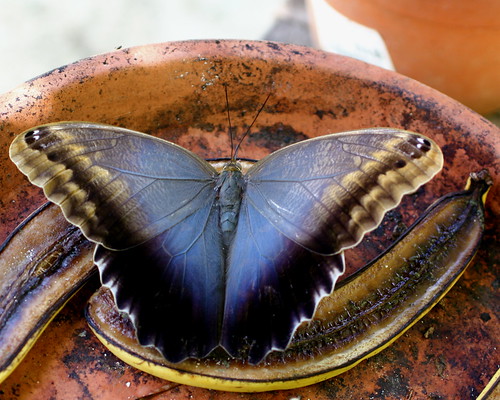
This photo of the Owl butterfly (taken at the St. Thomas Farm by the way!) is licensed to melingo wagamama on flickr via Creative Commons. The original photo is here.


Read more...

I'm Home

>> Tuesday, December 23, 2008

I am back in St. Thomas after a week (seemed longer) with the familia. I even went to the Miami Metro ZOO. It was awesome. I have a bit of pictures and lots of interesting animal facts to share with you! I am also WAY behind on science news. There have been a lot of important things going on with science. I don't know how I will catch up. For now though, I am going to go unpack my amazing art supplies. That was so nice to come home to... a happy dog and a pile of art supplies. Ok. I am a bit tired, but I promise I will post something sciencey. Soon.


Read more...

Updates

>> Tuesday, June 2, 2009

Hi all! Things are still moving a bit slowly for me here in Florida, but I think I finally have time to do more science posts. I have been looking at my schedule and I think I can work in a few posts a week now from Mom's laptop. I may steal her digital camera for a bit as well. This is a great area for birds and the like and there are a lot of native plants I could really do some posts on as well. I also finally got my camcorder and have a few opportunities to record some stuff. I have been riding the Pinellas Trail a bit and should be able to come up with something on my rides to and from the shop. I finally saw my first Eastern Tiger Swallowtail butterfly. I also saw two different Battus species. This is very exciting for me. Now I have to chase them down and attempt to take pictures. Many of the others I have come across are also native to St. Thomas so nothing new, but I am really excited about a lot of what I have seen.

Things at the deli seem to be getting into a steadier pace. We have more than a few "regulars" now which is always nice. The menu is coming along and we have added soup. Our house soup will be a tomato basil that is absolutely delicious. I promise that it is very unlike tomato soups you may have had in the past. We have coffee and tea service as well and our daily specials are finally gaining popularity. We are also working on game nights and things of that nature to bring in people after work. Scrabble is definitely at the top of the list!

Besides that, there isn't too much to talk about. I did get to see the hubs this past weekend, which was nice. It was hard when he left again, but I know this will all work out. I also found out that there is a botanical gardens close by and the best part is it is FREE to visit. I smell a video along the lines of the Viscaya one brewing! Probably better quality by now. You would think, at least, considering that was my FIRST video on this site! Well, I hope you all are doing well. Now that I have worked out a somewhat workable "break" break into my day, I will begin stopping by all of your blogs more regularly again. Have a great week!


Read more...

Mini Paintings

>> Saturday, January 24, 2009

I realized that my posts have been really formal recently and haven't let all my friends out in the blogosphere in on what has been going on down here. It turns out St. Thomas is NOT recession proof. While the number of people visiting has stayed about the same, sales all over are down and that means fewer (somehow) hours for Mimi. This is really bad because a certain male figure in the house has a commission based sales job. Mimi to the rescue, I hope! I have mentioned in passing that I do paint silliness every now and again. Surprisingly, in the middle of this economic disaster, the one thing people really want to buy is something locally made. My little side hobby of painting bags and mini canvases has had quite the surge in the past few weeks, so just to make myself feel better about the sorry state of affairs we are in now, I am going to show you some pictures of a few of the things I have done so far.


The picture quality is not that great, but they are from my cellular phone. They are little 2" x 4" canvases. No pictures of bags, sorry.


Read more...

grumblings about class

>> Monday, September 15, 2008

I don't even feel like being grammatically correct or anything... so excuse the following post as a scientist-in-progress moment of venting furiously while pounding on her keyboard. Phew! I have a few qualms about a certain professor and their knack for disclosing faculty information to us, the students. One, we don't care who you do and don't get along with. I will find that out at the bar with my other professor friends, not in class. Different setting. I paid for lecture here! Two, don't tell us on Monday that we have an exam in lab on Wednesday. What? We haven't even technically had lab and I don't remember learning anything and we have a test WEDNESDAY?!?!?! I am so grumbly right now. It would not bother me so much if we had a syllabus! We don't even know what this professor's email is! Somehow, however, the other professors NOT giving them a copy of their syllabi for this class is a race issue. I don't get this. Said professor cannot POSSIBLY accuse the professors here of being racist. I go to a HISTORICALLY BLACK COLLEGE AND UNIVERSITY! We are ALL minorities. The professors know this and teach here... in the Caribbean. They are NOT racist. The racist ones don't last a semester. Most of our professors have been here for 10 plus years! Why? Because they love the Caribbean and love teaching here! OMG! I wanted to strangle them. Thank goodness I can vent into cyberspace. Notice how I leave out what class it is this professor teaches and gender. I am hoping they are not one of the people in the VI who reads this thing. If this professor is, maybe they wil see the humor in it. Maybe they won't realize it's them.

To make me feel better, I am enclosing a happy iguana picture. The iguana (Iguana iguana, yes that IS the scientific name) is wild in St. Thomas and throughout the Caribbean. We don't keep them as pets here, but there are tons everywhere and they are so much fun! I mean look at this guy... he knows how to live in the tropics.

Read more...

Time Flies....

>> Thursday, July 2, 2009

I cannot believe that is has been nearly a month since my last post. I feel like such a liar. I am currently visiting the hubs in St. Thomas, which is nice, and just trying to relax. I have worn myself out a bit, but am still here. Just to give you the heads up.


Read more...

Saving Pupa

>> Sunday, October 26, 2008


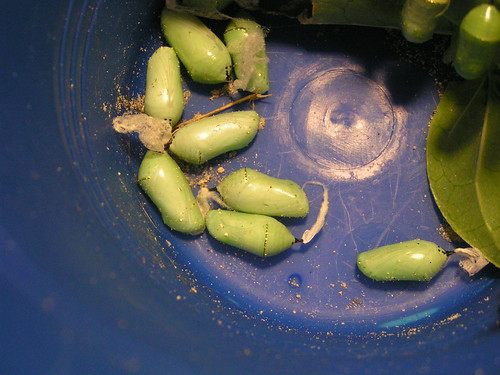
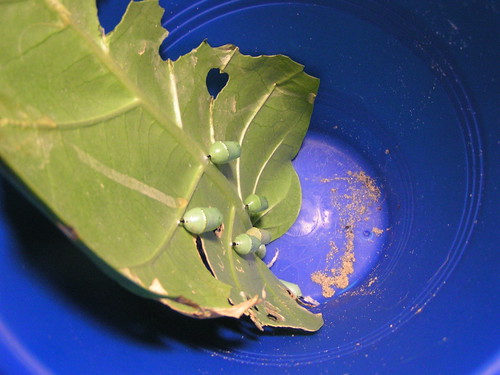
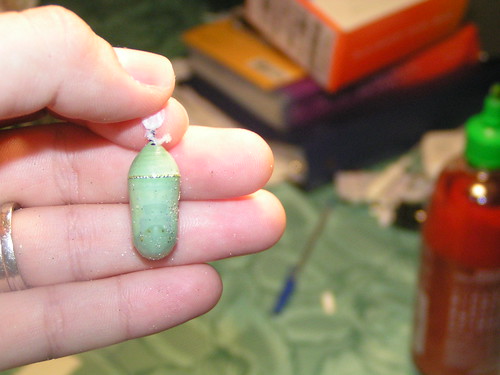
Today was a quiet day at work, but after work was fantastic. I went to my favorite beach, Brewers Bay, out by the university and came across something very exciting... I was looking at all the lovely monarch caterpillars munching on milkweed and lo and behold, PUPAE. Pupa is a fancy way of saying the third stage of an insects life. In the butterfly life-cycle, this is known as the chrysalis. It is a cocoon for moths... well there are a few exceptions, but I digress. These were lovely monarch chrysalises. Being the butterfly defender that I am, I had to take them to save them from unknown fate. We are actively breeding butterflies in St. Thomas, so we try to save the pupae (plural for pupa) in case they fall off the plant, get eaten, etc. Aren't they lovely? See the beautiful gold crown? That's why they are called monarchs! I got quite the haul. Did you see how many were on one leaf? So now I will mount them since they need to hang and keep them till they emerge and release them. I am so excited!

Read more...

Mongoose Madness

>> Tuesday, November 4, 2008


There are some furry little rodents that live in St. Thomas, and no, I don't mean the rats. And they aren't really rodents at all. We have mongooses here. Yes yes, like Rikki Tikki Tavi. They were imported to the West Indies to aid with rat and snake control. This had HORRIBLE consequences (NOTE TO ALL: don't import animals, EVER!). Now we hardly have any snakes, the few we DO have are now endangered, and the small fauna population in general has suffered (except for iguanas, they hide in trees). Since they no longer have much prey, they are now in decline as well. Funny how that happens! I wish I could show you a picture I took, but they are fast buggers and I have a lot of butt shots. Also, they are predominantly diurnal (day hunters as opposed to nocturnal) and I only have time as the sun is going down to stalk them. They recede very quickly as it darkens.

The image to the right is Herpestes ichneumon. This is the same genus as the species we have here, but not the same species. We have Herpestes auropunctatus. The picture here is from Wikimedia Commons and is in the public domain. Little by little, I think you all may become Virgin Islands wild life experts. Hehe.

Read more...

Earth Hour

>> Thursday, March 26, 2009


So I put a banner up at the top of the page. It is for the WWF (World Wildlife Fund) campaign to turn the lights out for 60 minutes. One hour your local time starting at 8:30pm. What is the point? Well, lights out always saves energy and if most of the people on a grid do this, that is a SIGNIFICANT savings. Mostly, however, it is a statement, a rally if you will, that you too want a better understanding of and solutions to climate change.

Last year there were iconic buildings like the Sydney Opera House who shut their lights out. This year entire cities are devoted. They are turning lights out in all the city buildings. Las Vegas and Hong Kong are on the list. Many high schools around the country are also participating and people are having various functions and power-free parties. There are even kids getting involved and doing their part.

The site above links to the UK WWF site. The US site didn't have as many tips but you can find it here. Even if you don't participate, it's nice to have a lights out hour anyway. Living in St. Thomas, it happens anyway as WAPA (Water and Power Authority) is not exactly reliable. The hubs and I are going to have a fancy candlelit dinner followed by a long walk with Floyd, I think. The easiest way to participate is to just go to bed early! To participate or to find out more, visit any of the websites. Are you participating in Earth Hour? What are your plans for the dark?


Read more...

Monday blues

>> Monday, May 4, 2009

It's official. I really am blue. Tomorrow I leave my beloved St. Thomas for Florida. Nick and I have spent the day revisiting spots in our history. It's ok. I know we'll be back. We have 6 years of history here. We met here. We got married here. While I am always up for a good adventure, it's a bit bittersweet in the end. New adventures await!

P.S. don't forget to sign up for my giveaway. I will do a drawing on the 10th at 5 pm EST.

Read more...

food for thought

>> Monday, July 6, 2009

I'm back in St. Thomas and got some computer time (WOOT!), but I will keep this short and sweet. It's all about agriculture.

There are sheep shrinking on a Scottish isle. Since 1985, the weight and stature of sheep on the isle of Hirta has declined 5%. What is causing this? Surprisingly, it's mild temperatures. Normally, with a grazing season longer than norm, one would assume that the sheep would be bigger and fatter, so what is the issue? Well, milder weather means the weaker and smaller sheep are surviving more, mixing in their genes. Also, with more surviving sheep, the smaller sheep are at an advantage if there is a food shortage since they won't have to eat as much. They are going through a period of natural selection.

Dairy is getting a lot of grief. I understand it. Mass dairy farming practices are a little gross, and the ammount of hormones used is outrageous. A lot of people think that dairy is bad for you. However, despite big farms' bad reputations, dairy itself is actually a healthy and cost effective way to get 9 super essential vitamins. You can find out more here.

The ADA (American Dietetic Association) did a study stating that if properly approached, a vegetarian diet can be healthy at any stage in life.


"Vegetarians tend to have a lower body mass index and lower overall cancer rates. Vegetarian diets tend to be lower in saturated fat and cholesterol and have higher levels of dietary fiber, magnesium and potassium, vitamins C and E, folate, carotenoids, flavonoids and other phytochemicals. These nutritional differences may explain some of the health advantages of those following a varied, balanced vegetarian diet."


You can find out more on the ADA website.

Sorry this was short. Be back later!


Read more...

I Feel the Earth Move Under My Feet...

>> Friday, October 10, 2008


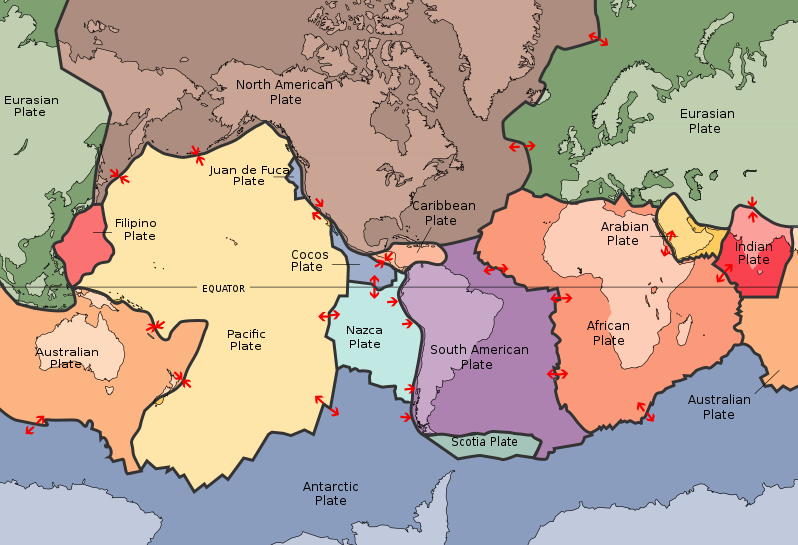
...and NO... it's not because I live near a train. St. Thomas is actually very earthquake happy. We have them here very frequently so they are all really small. Occasionally they get big enough to feel. A few weeks ago we had a little guy, but I felt it quite easily. It surprised me and Floyd had her tail between her legs. It was only a 2.7 magnitude quake, but being on top of a mountain makes it feel a bit bigger, I guess. I know I have been through bigger (according to news) but had no idea because I was at sea level. We have earthquakes here because we are on the edge of the very tiny Caribbean Plate. There are still some people who don't believe in tectonics, but regardless, there is movement from all the plates around us and we have earthquakes and volcanoes in this part of the world.

We are being pushed around by the (MUCH LARGER) North American Plate, South American Plate, Nazca Plate, and Cocos Plate. You can see the believed plates on the image at right.

I am not really sure why I started talking about this, but Maybe it is because the neighborhood dogs all started howling then got quiet, like the last earthquake... except Floyd. She doesn't make noise. Maybe when I remember where I was going with this, I will come back and add to it. *sheesh*

Read more...

Sexless Insects

>> Friday, September 26, 2008

Since most of you may not know, I work at The Butterfly Farm. This is a 10,000 sq. ft. enclosed tropical garden PARADISE for many species of neo-tropical butterflies. The location in St. Thomas is just over a year old but we have already had a great impact on the community and have helped to start local butterfly breeding programs at various schools and educate people on backyard butterfly gardening. This will explain why I am such an avid reader of Q's Corner, Bug Girl's Blog, and My Wildlife Sanctuary. You three give me hope for butterflies the world over... and your pictures, oh my!

So since so many of you love butterflies so much, I am going to give you a very brief rundown on our caterpillar friends and why they are important even though many think they are a nuisance.... Bug Girl, you are the expert so feel free to correct me.


Parthenos sylvia, Common: Sylvia or Clipper


I have no caterpillar pictures today, as I am horrid at taking them, but I am posting some of my friends from the farm.


Caterpillar Facts:

First off, we sciencey types refer to them in this stage as "larva." I always tell people it is because caterpillar has too many letters to type!

  1. Caterpillars (on average, mind you) have eight pairs of fleshy appendages that most consider legs. Really only the first 3 pairs are legs. We are trying to convince ourselves that they are insects and insects have 6 legs, like butterflies do. The other legs are "prolegs."
  2. Caterpillars have 6 pairs of very pathetically weak eyes (ocelli) right around their mouth so all they can see is the food in front of them. This is good since they are voracious eaters. Compare this to the butterfly again and notice butterflies have 2 very complex compound eyes on either side of their head.
  3. Since all they do is eat for 2 weeks, they are sexless (hence the title of this post). No need for males and females if you aren't mating!
  4. Caterpillars can consume 20 times their weight in food a day. That is approximately half a ton for an average 7 year old.
  5. Since they eat so much, they also "poop" a lot. We call this frass. Frass is good for your garden! It's free fertilizer. Believe you me, any of you with monarchs around know, monarchs make A LOT of frass.
  6. Caterpillars grow approximately 2,700 times their original size in their average lifespan of 2 weeks. If we had a newborn eight pound baby that ate as much as a caterpillar, that baby would be over 20,000 pounds at the end of 2 weeks. That is 10 tons of baby fat!
  7. MOST IMPORTANT THING TO KNOW!!!!! Caterpillars all turn into butterflies or moths. I know this seems obvious, but it bugs me (no pun intended) when people come in and tell me they hate caterpillars and kill them all the time but then the next breath mention how they don't see as many butterflies as they used to.... gee, really?!?!
The fact is, caterpillars will destroy certain plants, to an extent. We know what these plants are, so do yourself a favor and plant an area that is butterfly friendly... sacrificial plants, if you will. I don't mean a butterfly bush here guys. I mean host plants. You find a caterpillar on your dill, you move it to the dill in the butterfly safe zone. They can't hurt you and they will stay there since there is food. This will lead to more butterflies in your area because you will not only have flowers for them to get their alcohol (more on that later), but host plants to lay their eggs on. This, in turn helps to pollinate your garden and others the world over, increasing the overall genetic diversity of plants, making them stronger.

Butterflies are super-pollinators. Without them, we would starve to death.


Idea leuconoe, A rare butterfly in the wild, breeds well in captivity
Common: Paper Kite, Tree Nymph, Rice Paper Butterfly


Creative Commons License
P. sylvia and I. leuconoe by M. Moya is licensed under a Creative Commons Attribution-Noncommercial-Share Alike 3.0 United States License.

Read more...
Related Posts with Thumbnails
WARD'S is a one stop online store for science education.
CommentLuv Enabled Charles Darwin Has A Posse Science Blogs - Blog Catalog Blog Directory Blog Directory by Blog Flux

  © Blogger templates Palm by Ourblogtemplates.com 2008

Back to TOP