JS-Kit Comments

Showing posts with label invertebrates. Show all posts

Flex Your Mussels

>> Thursday, September 12, 2013

Epioblasma raniana
Freshwater mussels play a vital role in aquatic ecosystems. They are amazing filters and are capable- in tight clusters- of filtering as much water as a treatment plant. It's no wonder why researchers working with the Illinois Natural History Survey, a division of the University of Illinois, have been working so hard to save two endangered species or mussel.

They moved individuals of the two endangered species- the northern riffle shell (Epioblasma rangiana)and the clubshell (Pleurobema clava)- from the Allgheny River in Pennsylvania to another area in the Ohio River Basin in Illinois. The species hadn't been seen in this area in about 100 years and have been transplanted with an 80% success rate. The area they were moved from was a site due for bridge restoration which would have greatly impacted the already dwindling numbers of these mussels.

You can read more at the University of Illinois site here.

Read more...

News Snippets: Grapes, Ginger, Beetles and Butterflies

>> Monday, January 10, 2011

Three snippets that I found interesting today follow: two are about food and one about butterflies. The second one also has to do with beetles. Woo, invertebrates! Could my day get any better?

  • Grapes made the news again. Well, actually, resveratrol did. I have posted about this interesting compound a few times on Potspoon! and I am still waiting on the reveratrol beer. Well, besides the fact that this compound is good for its anti-aging properties, it also appears to display anti-obesity and anti-insulin resistance. You can read the article here. 

Fig 1. Yum
  •  In an article published in Insect Conservation and Diversity, good news was found for the UK's incredible stag beetle and good news come in the form of a root. Ginger is useful in the kitchen, sure, but it is also useful as bait to lure stag beetles. Researchers have also devised a method using tiny microphones to hear larvae underground. This all helps determine numbers of the rare beetle and can aid in its conservation. You can read more on ScienceDaily as well.

    Fig. 2 Not the right species of butterfly, but a butterfly nonetheless
  • Squinting bush brown butterflies, Bicyclus anynana, seem to have a bit of role reversal in mating behaviors. This confusion only seems to occur when changes of weather happen. When it's cool, females act as the aggressors and flash their wing patterns. In this species the males and females have the same eye spots, but the UV patterns change dependent on temperature. In warm moist conditions, the males have more flashy designs while the females are dull, but when the temperature drops, new males and females are opposite. It's the females that are flashier and spend time displaying. You can read more here.
 Hope you all are having an awesome Monday!

Photos: Grapes from Google Creative Commons search and butterfly from Paraflyer's photostream. Both lisenced through Creative Commons.


Read more...

Monarch Medicine

>> Wednesday, October 13, 2010

Fantastic article on ScienceDaily about monarchs medicating their offspring. You all know how much I love butterflies. Pretty amazing that the host plants the larvae eat can actually reduce parasitic infection. Go inverts!


Read more...

Building Mussels

>> Friday, April 16, 2010


This is a fantastic video produced by Defenders of Wildlife. The video talks about things that are being done today to help restore freshwater mussel populations and why these shelled invertebrates are so important. The comprehensive effort is bringing back many species from the verge of extinction as well. In particular, they mention some of the endangered species that they have actually been able to successfully breed in a controlled setting.

Be careful watching though... you just might learn something!


Read more...

Seeing Stars!

>> Sunday, March 21, 2010


I realized that after doing a few Name That Creature posts on Facebook that I should really make sure many of the creatures featured have a post on Potspoon! to make it easier to look up. First on this list of creatures I have skipped is the reticulated sea star or the cushion star, Oreaster reticulatus. Adults get beautiful reds, browns, and yellows that are striking and easy to spot while snorkeling or diving. They can also reach sizes of 50 cm (almost 20 inches).


This sea star is very common in the western Atlantic and is a very visible creature in sea grass beds throughout the Caribbean. Since they spend much of their lives in sea grass beds, the juveniles are green in color to blend in with their surroundings. They rarely hang out in deeper waters. Here in the Virgin Islands you will find them amongst the Thalassia testudinum beds. If you recall, T. testudinum is referred to as turtle grass and is also where you commonly find our friend the queen conch.

Hanging out in these turtle grass beds allows them a diverse diet consisting mainly of sea sponges that wash in from reefs and various forms of mollusks. To eat, they actually put their stomachs out of their "mouth" then digest partially what they are consuming. When ready, they suck their stomachs back inside!

Like is the norm for echinoderms (although exceptions always seem to pop up), they use a water vascular system for structure and to use the tube feet they move around with. Believe it or not, these guys are related to urchins and sea cucumbers! There are many reasons how, but perhaps we will save that for another post!

Now you know a basic rundown of the amazing cushion (or reticulated depending on where you get your info) sea star. Feel free to leave any questions in the comments!


Read more...

Flamingo Tongue

>> Wednesday, October 14, 2009


Now that I am all well rested from my "staycation" I have lots of pictures and science-y tidbits to share. This amazing photo my hubby took above is of a flamingo tongue (Cyphoma gibbosum). See the brightly colored shell on the sea fan? It's that. Now you will get to learn a little about this amazing creature.

Habitat:
This beautiful snail lives its life hanging around on gorgonian type corals. These commonly are sea fans and sea whips. They are found in shallow waters to depths of about 10m (30 ft.). Its range is the southern Atlantic and Caribbean. This is the area between North Carolina and Brazil.

Family Origins:
This colorful little guy is a gastropod. That means he is a mollusk along with some of our friends the squids, snails, and slugs. They are part of the family that is commonly known as the cowries.

Fun Facts:

  • The colors on the shell are not actually on the shell. It is actually a layer of tissue outside of the shell. Once the snail dies, it is really just a plain white or light peach colored shell.
  • They cannot survive without coral reefs. They live on and feed off gorgonians (octocorals). Both the flamingo tongue and the coral they feed on are invertebrates.
  • Like all gastropods, the flamingo tongue eats with its foot. The thing any snail crawls along the surface with is known as it's foot. They eat as they are moving!
  • They have very few predators because, as the brightly colored shell indicates, they are distasteful.
  • The maximum size is only 1.5 inches.
  • They are diurnal (sleep at night) just like us! Well, most of us. :D
  • Flamingo tongues are getting more rare as visitors to the Caribbean mistakenly snatch them up for their colorful shells. Now that you all know they aren't really colorful, you won't take them, will you?
I hope you have enjoyed this introduction to yet another animal found here in St. Thomas.

Don't forget: The Donor's Choose Challenge is going on 'til the end of October. Make a difference in school children's lives.


Read more...

Arctic Creatures Photos

>> Wednesday, September 2, 2009

The BBC posted a series of pictures of creatures (many of the invertebrate persuasion I am partial to) that will likely take your breath away. Scientists recently released photos of many of the "jelly-like" creatures they encountered using submersibles to dive into the Arctic. They are stunning, to say the least. Sadly, this is all I have as it appears to be a slow news day. Most of the news is about our mutated genes and how related we all are. Really, though, go look at the photos... they are out of this world.


Read more...

The Carribbean Reef Squid

>> Friday, July 24, 2009

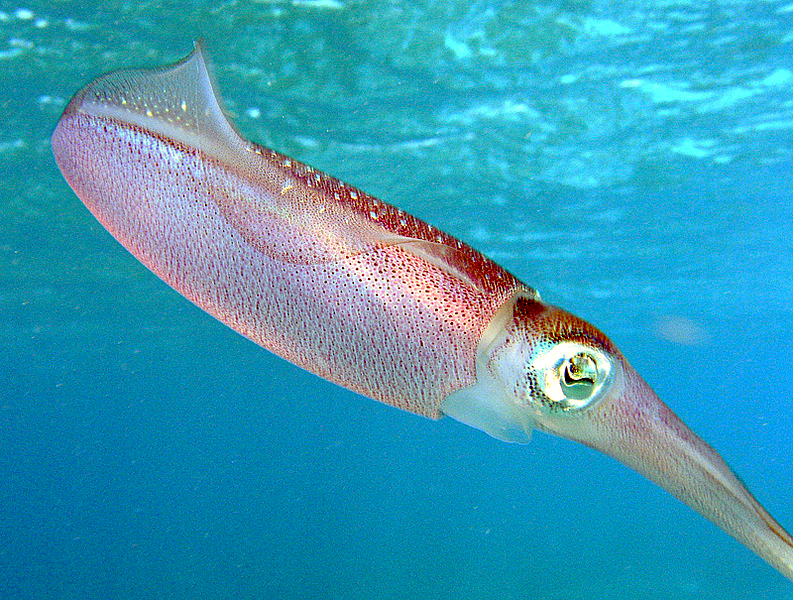
fig. 1 Caribbean Reef Squid. Photo in the Public Domain


I went snorkeling yesterday with my hubby at Secret Harbor on the East End and one of the many forms of sea life I saw was the Caribbean Reef Squid (Sepioteuthis sepioidea). Now you may not have realized it yet, but I have a thing for invertebrates, so I was inspired to do this post. Plus, I had some groovy lab drawings from a squid dissection that I labeled on the compy for you. If you have any questions about the functions of any of the parts labeled, just let me know so that I can answer any questions for you. This is just the basics of this really alien and beautiful creature.

This squid is commonly found throughout the Caribbean and Floridian waters. They are usually found in shallow waters (1 meter or less) and are commonly seen in schools. I usually see between 5 and 15, but apparently will congregate in groups as large as 40. They are mollusks so, believe it or not, are related to the Queen Conch I posted about last week. Since they are further classified as cephalopods, they are more closely related to octopuses, cuttlefish, nautiluses and more. They are quite pretty and many time I have seen them flash colors at each other or in time. They are very colorful, almost iridescent creatures. The speed of color change in them is quite fast as well. In fact, they can change color much faster than a chameleon.

They swim (or hover) using the fins (click image below for larger view) on the sides of the mantle. If they need to get away quickly, they use a form of jet propulsion. If they still can't get away, they ink.

When they aren't hovering, they eat. They eat a lot. The Caribbean Reef Squid, like most squid can consume almost 50% their body weight in food a day. They are carnivores and eat a variety of prey including crustaceans, small fish, and even other mollusks.

fig 2. exterior of squid

One of the things that makes squid and cephalopods so interesting to study is their fantastic sight. The reason they are so studied is they are not even close to being related to vertebrates, yet process images similar to us. This means that their sight and eyes evoloved independently. The main differences are the ammount of visual pigment. They usually have one, we have three. They pretty much only see in greyscale, which is suprising considering the amazing display of colors they put on for us! There is one exception, however, but we won't complicate things. You can learn more about the coevolution and how their eyes work here.

fig 3. internal anatomy of male squid

Squid are know to be "weed like" in how they grow and reproduce. There are only about 800 species but in terms of production can keep up with fish. This makes fish an incaluable resource globally. The common market squid in Southern California (Loligo opalescens) alone is responsible for about $20 million in revenue a year. That is just the fishery side as well. That does not include uses for its ink, the money made in restaurants that sell it, or the money made from bait and tackle, etc. Due to its fast rate of reproduction, it is alsoconsidered one of the more sustainable types of seafood you could eat. Many questions have yet to be answered though. We don't know where many of these species spawn and just how many are out there. There was a great article published that attempts to show the effects of squid fishereies.

Besides all the info I just gave you, did I mention that they are awesome to swim with? I've only seen them at a few beaches here and absolutely everytime I see them, it's mesmerizing.

I hope you enjoyed my sketches. Happy learning!


Read more...

Save the Queen... Conch, That Is!

>> Tuesday, July 14, 2009


I put a desktop picture up I found in our underwater photo archives and it's so cute, I decided to do a post on it. Previously known as Strombus gigas and now Eustrombus gigas, it is commonly known as the Queen Conch (pronounced konk) and is the species I will be talking about today.

Conchs are gastropods and means they are closely related to snails and a little more distantly related to squid as squid are mollusks as well. Here in St. Thomas, they can be found in shallow (less than 10 meters) water with sandy substrate mixed with a lot of Thalassia testudinum also known as turtle grass. Yes, it is called turtle grass for a reason and we will save that for another day. I go conching here (not to harvest, but for research) at Brewers Bay by the university. You can see in the picture provided, this guy is hanging out in sand and grass. For more fun, if you click on it, you will see his eyes poking out. Super cute. Anyway...
Most people that know anything about conch know that they will "attack" you. It's sort of true. You see, conch, like many gastropods, have an operculum. This is simply a covering at the bottom of his foot that seals the shell closed. If you have ever looked at marine snails or whelk, you will have seen this. In the conch it is particularly long and claw like. They will use it at times.

Another feature of their anatomy, and arguably the most dominant, are their spiraled shells. Many people are familiar with conch shell horns and the like. They are quite beautifully pink on the inside and are prized by shell collectors. Conchs also produce pink pearls that are very collected.

Locally, they are prized for their meat. We have conch fritters, conch stew, buttered conch and more. It is quite tender and yummy. However, this beautifully shelled animal is threatened. Illegal harvesting has devastated the population of conch in our waters. They are protected in Florida and in the Virgin Islands are harvested only certain times of year and must be a certain size. "Lip-less" conchs cannot be harvested as they are still juvenile. The rules are as follows:

A quota of 50,000 lbs per year. After the quota is reached, the fishery will remain closed until November 1st of the following year. A limit of 200 conch per boat for licensed commercial fishermen. A limit of 6 Conch per person for recreational fishermen and a total of 24 conch per boat. A closed season from July 1 until October 30. All conch must be landed alive and in the shell. No conchs may be possessed which are less than nine inches in length or less than 3/8 inch lip thickness. Fishermen must report their landings monthly to the Division of Fish and Wildlife.

Also keep in mind that there are times of year to harvest them. If we don't keep track on what we are doing now, we may not have them to enjoy in the future. They are already in serious decline and that is why these regulation are in place here. In Florida, they are considered threatened now and harvesting is prohibited in the majority of US waters. Even if you see an empty shell, try not to remove it as many species of marine hermit crab use these shells as well. I have reported illegal conching and it is quite easy. Remember, in the continental United States, harvesting is illegal. you can contact any natural resources division in your state. If you are in the USVI you can call DPNR at (340) 774-3320 in St. Thomas and (340) 773-1082 in St. Croix.

You can find out more at NOAA and at your local DPNR website.

Book used as reference:


Read more...

Florida Botanical Gardens

>> Sunday, June 7, 2009

Hey everyone! I hope you all have been having a great weekend. Yesterday after work I went on the hunt for that great Botanical Gardens I mentioned in my last post. I did find it and it's so neat. I can't wait to go back with more time so I can get some footage and more pictures. Mom and I got there at around 6:30pm and it closes at 7.

The website for the garden is here. They had butterfly gardens planted as well and I saw lots of really cute bugs and caterpillars everywhere! The plants were marvelous as well and seeing how lovely they gardens were without the use of grass made me dislike lawn grass even more. Besides being a waste of LOTS of water, it's not really useful for any of the wildlife here in Florida.

Fig. 1 Battus polydamus caterpillar on pipevine

The above caterpillar is easily the biggest caterpillar (not longest) I have ever seen. He was fatter than a really big cigar! The common name is the Gold Rim and it is a lovely butterfly. It is the only tailless swallowtail butterfly in North America. The species is also unique in that the chrysalis will be different colors depending on where it pupates. If it pupates near a leaf, the chrysalis will usually be green. If it pupates near a dead leaf or vine, it will usually be brown.

Fig. 2 Southern Lubber Grasshopper Romalea guttata

I also saw this really beautiful grasshopper. It is a flightless grasshopper and also one of the most colorful in Florida. It is occasionally a pest to daylillies and citrus.

I can't wait to go spend more time at the Botanical Gardens. I only went to a very small portion of the 183 acres. Not too much time to see much when you go 1/2 hour before closing. See you guys soon.


Read more...

End of Week Animal News Snippets

>> Saturday, March 21, 2009

This has been an exciting week for animals in the news so we will just get to it:

  • First off, there was that weird spider thing in Oklahoma. In the end, the body was destroyed (stupid) so we still don't know if it really was a Brazilian wandering spider or a Huntsman spider. People from the University of Tulsa and the Tulsa Zoo seem to disagree on the identification of it. Since there is no body, we may never know.

  • A lizard that had not been found on mainland New Zealand for 200 years was finally found! The tuatara can grow to be up to almost 3 feet in length from nose to begining of tail. That is about the size of our giant iguanas on island. It was found by people at the Karori Sanctuary.
  • Scientists are figuring out why some birds are disappearing. Many of the factors causing the disappearance of our feathered friends include climate change, disease, invasive species and habitat loss.
  • A pink elephant has been caught on camera. The super cute thing may be an albino which does not bode well for the little calf. The harsh environment of Botswana may give the calf skin problems, blindness, and more. Elephants are smart though and the little calf already only walks in the shade of it's mother.
  • More proof of primates using tools has been recorded on film. Chimps in the Republic of Congo are on video making clubs out of branches and breaking open hives to reach the honey inside. If that wasn't enough, they then scoop the honey out using "dipping wands."
I hope this helps with your science fix. I know it helped mine.

Sorry I have been so absent. More hours at work has me a bit exhausted by the time I come home. There is only so much science you can teach in a day.


Read more...

Self Medicating

>> Friday, March 13, 2009

And no, I don't mean habitual drug use.... Researchers have found that woolly bear caterpillars actually will try to medicate themselves if infected by parasites. Parasitic flies lay their eggs inside woolly bears and when the eggs hatch the woolly bears get eaten from the inside out. Gross, I know. What these researchers discovered was that woolly bears that are infected have the tendency to eat more plants that kill off the parasites than their non-infected counter parts. Sounds smart to me... well, smarter than we were giving them credit for anyway.

Ay, me... unfortunately that is all you get today. Until Floydine feels better, I have a hard time focusing. Sorry guys.

The original article was published in PLoS ONE.

Singer MS, Mace KC, Bernays EA, 2009 Self-Medication as Adaptive Plasticity: Increased Ingestion of Plant Toxins by Parasitized Caterpillars. PLoS ONE 4(3): e4796.doi:10.1371/journal.pone.0004796


Read more...

More Fantastical Ocean Discoveries

>> Friday, March 6, 2009

NOAA (National Oceanic and Atmospheric Administration) found new deep sea corals. In fact, they found seven new species while on a mission at Papahānaumokuākea Marine National Monument. Six of them may be entirely new genera.

The discovery is very exciting because corals of any kind have the tendency to be the basis fore any marine ecosystem. They are also the first ones affected by ocean acidification. Since these bamboo coral produce growth rings like trees, they can tell us a lot about conditions on the ocean floor and how they change.

Also among the discoveries were new coral beds and a large sponge dubbed the "cauldron sponge." It was about one meter across and tall. Other sponges were discovered as well and may also represent new genera. There were also coral graveyards found with dead coral of a variety that had never been documented in Hawaii before.

Papahānaumokuākea Marine National Monument is very studied because it is the largest preserve (US Protected) of ocean floor that is below SCUBA depth. 98% of it is "deep water" and must be reached by submersibles. This is an exciting year for deep sea discoveries and it's only March!

Photo courtesy of NOAA.

Read more...

New Deep Sea Species

>> Saturday, January 24, 2009

In National Geographic, there was an article showing three new deep sea species that they have found. This one is my favorite.

It looks like some strange breathing apparatus or something. Apparently it is a sea squirt living 4006 meters underwater. It was about 20 inches long and was found to be carnivorous. The funnel is used to trap small fish and other things. This is strange because other ascidians (sea squirts) we are familiar with simply siphon plankton from the water as filter feeders.

This strange creature, and more, were found off the coast of Tasmania in the Tasmania Fracture Zone. You can read the rest of the article and see the original picture here.


Read more...

Red to "Dye" For

>> Thursday, January 15, 2009


Since I seem to be a bit into invertebrates, especially those of the insect variety, I decided to help out a fellow blogger with her quest for dispelling misinformation. Bug Girl is an entomologist so she definitely knows her bugs. Recently, bugs have been in the news a lot. This has been by way of Cochineal. These little scaly bugs are a source for a very vibrant natural dye in the shade of carmine. People seem to be freaked out that there are "bug" derived dyes in many of their foods. Honestly... this is way better than tar derived color. I don't mind bug color.

Like Bug Girl, however, I do mind misinformation. Articles in the New York Times, Scientific American (shame) and others all have done articles about this bug. Many of them refer to it as a beetle... not even close. NYT and SciAm finally removed the pictures that were not the same creature. After a few of us (yes, me too) left some comments about SciAm's need for a fact checker, the picture was removed and this was placed at the end of the article:


Editor's Note (posted 1/11/09): In response to some concerns about the entomological accuracy of this post and photo, we have taken down the image that was originally posted, because it appears not to be a cochineal insect. We are checking with the source of that photo to confirm its identity. The term "beetle" is often used to describe this insect, but we have changed the wording in the post to "cochineal insect" for strict accuracy. This post is based on the FDA's announced rule change, which was published on January 5 and which we link to in the blog (and again here) for interested readers eager to know more about how the agency reached its conclusions.


What does this have to do with Bug Girl's quest? Simple. She wants everyone who cares about this important little industry (yes, bug dye is an industry) and the facts about the cochineal by reading her great post. I know, I know... now I'm sending you somewhere else to read science stuff! What happened to your science phobia? Hopefully I'm wearing you down! Happy Thursday!

Photo is from 7-how-7's photostream on Flickr and is licensed under Creative Commons.


Read more...

The Honeybee Dilemma

>> Monday, December 8, 2008

Since so many of you seem very into bees (i.e. they backyard beekeeper here, the actual beekeeper here, and the bee lovers here, here, and here to name a few) I figured I would post the latest discoveries pertaining to CCD or Colony Collapse Disorder. This is what is causing the bees to disappear. We didn't know what was going on with the bees because there were no bodies to study.

At Penn State, the head apiarist (fancy science talk for bee genius) started doing research on these bees in greenhouses. Many theories had been tossed around as to what may have caused this. What it seemed to be, however, was something that not many people thought of as an option: A virus known as IAPV was to blame.

News of this spread quickly in the scientific community. Researchers stated that not enough work had been done to say for sure and then we forgot about those findings.

Then earlier this year a scientists finds that there are highly toxic levels of chemicals inside some of these bee bodies. In fact, they were able to find traces of pesticides in the wax and honey of these bees as well. Bees will go as far as they have to in order to reach food and if the food is covered in pesticides this can be transferred to the rest of the hive and product. Because of this, many beekeepers are asking farmers what, if any, pesticides they use before they rent out their bees.

What does this mean??? We have to protect the few bee colonies we have.

Photo: Honeybee on opening yellow flowers
Originally uploaded by Martin LaBar


Source article: here.


Read more...

Moth Evolution We Can See

>> Thursday, November 6, 2008

Butterflies and moths are harmless animals, right? I mean, until today, even I thought they were. They only drink nectar or fruit and fly around getting drunk. They don't have anything that can hurt you. Well, this was until I read a Halloween post on Wildlife Promise, a blog run by the National Wildlife Federation. On this post I saw something AMAZING. The following video is from the National Geographic website.

You can find out more here. Scary, huh? This really freaked me out a bit. Happy little moths are evolving a thirst for BLOOD?!?!?! eek! Nature is amazing.They have been dubbed vampire moths. I am just happy that, as of yet, they are found only in Russia near the China border. I can't wait to see what we find out about these guys.

Read more...

Potspoon! Making an Emerging Cage

>> Monday, October 27, 2008

This is a quasi-instructional video teaching you how to make a simple "pupa box" using a shoebox, paper towels, glue, and pupae of course! In this episode I am hanging glorious monarch butterfly chrysalis. Make your own and save some butterflies!

Read more...

Update on Pupa

I finished the temporary emerging cage for the pupae. They are all hung and ready to go. I will hopefully post pictures as they emerge (if I am here). I am making a mini video on how to make one of your own so you can be a butterfly defender, too. It should be up tonight... I hope. I know the "other" videos I promised haven't been posted, but this is short and not really "wildlife" related, so editing was a breeze. Oh, I am SO making a butterfly defender logo/award. There are some of you that really deserve one already! Don't the pupae look happy and cozy? By the way, singular or plural is pronounced PEW-puh, although some sticklers pronounce the plural form PEW-pee but I think that sounds gross.

Creative Commons License
emerging cage by M Moya is licensed under a Creative Commons Attribution-Noncommercial-Share Alike 3.0 United States License.

Read more...

Saving Pupa

>> Sunday, October 26, 2008


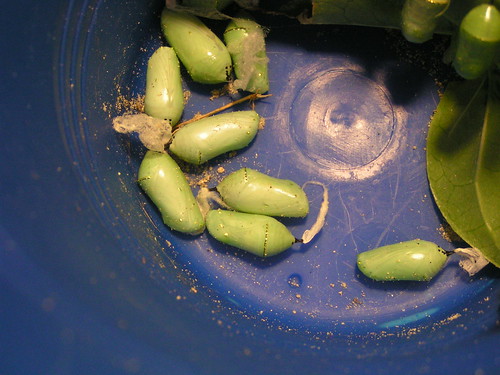
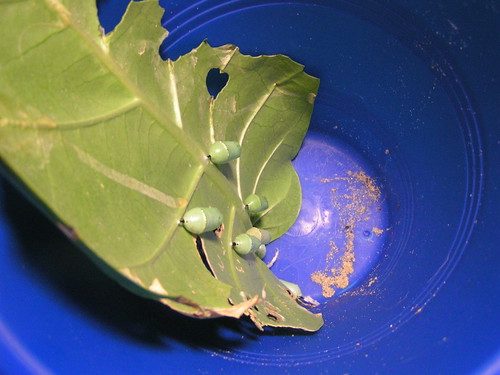
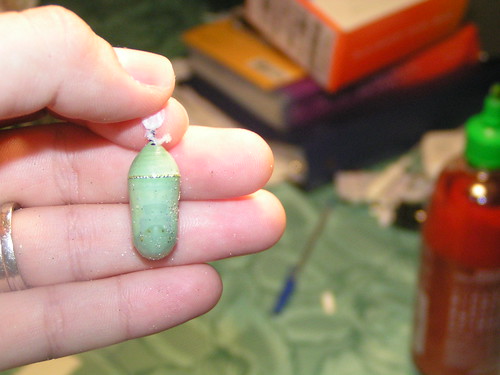
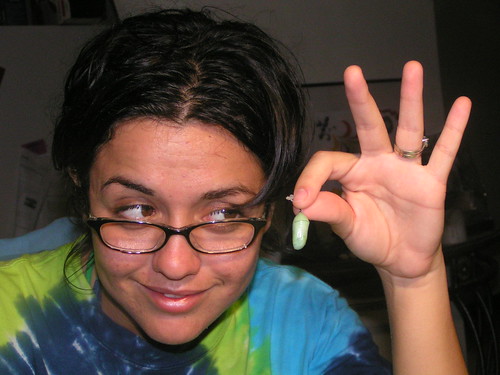
Today was a quiet day at work, but after work was fantastic. I went to my favorite beach, Brewers Bay, out by the university and came across something very exciting... I was looking at all the lovely monarch caterpillars munching on milkweed and lo and behold, PUPAE. Pupa is a fancy way of saying the third stage of an insects life. In the butterfly life-cycle, this is known as the chrysalis. It is a cocoon for moths... well there are a few exceptions, but I digress. These were lovely monarch chrysalises. Being the butterfly defender that I am, I had to take them to save them from unknown fate. We are actively breeding butterflies in St. Thomas, so we try to save the pupae (plural for pupa) in case they fall off the plant, get eaten, etc. Aren't they lovely? See the beautiful gold crown? That's why they are called monarchs! I got quite the haul. Did you see how many were on one leaf? So now I will mount them since they need to hang and keep them till they emerge and release them. I am so excited!

Read more...
Related Posts with Thumbnails
WARD'S is a one stop online store for science education.
CommentLuv Enabled Charles Darwin Has A Posse Science Blogs - Blog Catalog Blog Directory Blog Directory by Blog Flux

  © Blogger templates Palm by Ourblogtemplates.com 2008

Back to TOP