JS-Kit Comments

Showing posts sorted by relevance for query gorilla. Sort by date Show all posts

Get Your Gorilla Education

>> Saturday, February 28, 2009


So if you have been keeping up with the fact that this year is the Year of the Gorilla according to UN, you know that I am attempting to do a post a month with some gorilla news. You can keep up with all the ape business by clicking my fancy link all the way at the top of the page that says "Year of the Gorilla"... creative, I know. I even made a reading list with all sorts of great books on things gorilla. You can find that to the left. I'm done with the gorilla tour now on to the news.

The World Association of Zoos and Aquariums (WAZA) has teamed up with YOG 2009 to bring you an amazing manual/educational resource aimed at teaching people about gorillas. While the PDF is aimed at children, it is well worth the read. I learned a lot reading it myself. I can now tell the difference between apes by their noses and found out what an apes daily schedule looks like. I also learned that a gorillas upper body strength is six times that of a human. I won't tell you anymore because I don't want to spoil the fun. There are even little mini games to test yourself with. It's 36 pages of gorilla madness. There are even "logs" for gorilla watching and other activities if you go to the zoo and it's all finished off with a fantastic ape mask. The above is a snapshot of the manual. So go and read... I promise you will learn something, unless you wrote the manual of course!


Read more...

2009 is the Year of the Gorilla

>> Tuesday, December 2, 2008


It's official. UN has made 2009 the Year of the Gorilla. This was done in an effort to raise awareness for this closely related to us endangered species. Initiatives include education about the animal and efforts on conserving their habitats as well. This is quite important as many experts believe that gorillas will be extinct in the wild in the next 10 years. This is believed because in the past ten years the population has dropped from 17,000 to just 5,000 in the Eastern Lowland Gorillas in the Congo. That is a frightening number. The decline is staggering and has a number of contributing factors. Conflicts, habitat loss, disease and poaching for bushmeat are some of their biggest threats.

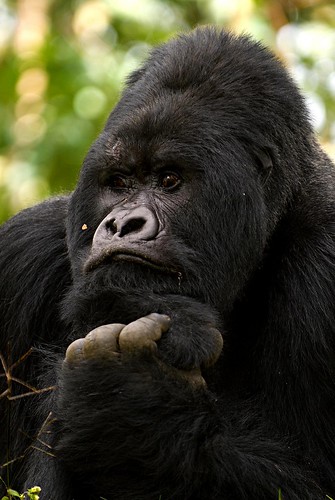
The picture here is a Mountain Gorilla (Gorilla beringei). The species was first describe in 1847 by Thomas Staughton Savage, an American physician missionary. The males blue-black saddle (back side) turns white or silver with age, hence the term "silverbacks." Mountain Gorillas like high altitude terrains and are found in protected areas in the Democratic Republic of Congo (DRC), Rwanda and Uganda. These gentle giants are herbivorous meaning they only eat plants.

The social groupings they form are called harems. They are called such because the one or two dominant males surround themselves with unrelated females. This is unusual because in many other primates the females are all related. It is usually the kinship bonds between the females that allow for stable groups in these other primates, but in these gorillas the relationships are based purely on the individual relationships of the females to the silverback. When young gorillas reach maturity they leave the group. A young female will attach herself to another young male or find a new harem to incorporate herself into. Young males will remain solitary until they can attract females to themselves and start a harem of their own.

The mountain gorillas have some of the smallest populations of gorillas and it is estimated that between 650 and 680 individuals exist in the wild (Gray et al., 2003 and McNeilage et al., 2001).

To find out more, click the links above or go to Year of the Gorilla, Koko.org, or the Dian Fossey Gorilla Fund. Just to help you remember, Koko is the gorilla who has an amazing vocabulary in American Sign Language and Dian Fossey wrote the book Gorillas in the Mist. The movie was based on her life.


Photo is copyright under Creative Commons Non-Commercial-Attribution License from YoungRobV's Flickr Photostream. You can find the original here.

Read more...

Great Gorilla Run

>> Tuesday, September 1, 2009

The Great Gorilla Run is an annual costumed marathon charity event in London. It has also started expanding to other large cities like San Fransisco and New York. The participants dress as gorillas to raise money for gorilla conservation. Since it is the Year of the Gorilla, the UN ambassador for YoG2009 is participating in the race. It seems like a very fun way to help raise gorilla awareness. Nothing like a pack of 500 people running through London streets in ape costumes to get ones attention!

The ambassador, Ian Redmond, is currently traveling to gorilla habitats throughout Africa and you can follow along on his blog. If you are in the London area and wish to participate, they are still taking applications. There are many ways you can help.


Read more...

Happy Gorilla News

>> Wednesday, January 28, 2009


In case you forgot, 2009 is the Year of the Gorilla. I figured I would attempt to do one post a month on these amazing creatures and today was the day for January. Luckily, I have some really happy news this time. Virunga National Park in the Democratic Republic of the Congo just completed a survey stating that despite the conflicts, habitat loss, and poachers, gorilla numbers are up 12.5%. The press release is here and everyone is excited. There are even stories on the yog2009 site, BBC, and National Geographic.

Why all the publicity for these guys? Well, it is officially Year of the Gorilla and there is a serious war going on in the Congo. The most amazing part of all this? The apes went without protection for about 15 months during the conflict. The national park has a 680 person strong ranger force to protect the now estimated at 211 gorillas. Ten babies were born during the 15 month the rangers could not be there.

They still, however, need our help. There are lots of things you can do to ensure these majestic animals will be around a bit longer. To find out more, you can go to yog2009 (Year of the Gorilla official website) or GRASP (run by United Nations).


Photo is licensed under Creative Commons
Attribution-Noncommercial-No Derivative Works 2.0 to bertieboy70 on flickr. You can find the original here.


Read more...

Gorilla Brains

>> Friday, October 17, 2008


As humans, we use the left side/hemisphere of our brain for communications skills. Well, apparently, so do gorillas. This is according to a recent study done by the University of Sussex. This is a snippet of what was posted on ScienceDaily:

"We shared 23 million years of evolution with great apes and then diverged approximately six million years ago. Gorillas have highly-complex forms of non-verbal communication. I think we are looking back at what sort of communication skills we may have once had."

Previous studies by other researchers have found that chimpanzees show a right-handed preference for manual tasks. But Dr. Sebestyn Forrester's research is the first to indicate a link between right-handedness and communication in apes.


She goes on to explain that apes use a lot of the same nonverbal communication we do: hugs, smiles, eye gazes, points, frowns and tons more are examples. Now while many won't agree with the evolution bent on this.... it is amazing how brilliant these animals are. Hopefully this will encourage people to save these intelligent creatures from almost certain extinction. To really see the dynamic social interactions between gorillas, there is a great movie, Mountain Gorilla
that really makes you see how similar their reactions and interactions are to humans'.

Of course, no topic about gorillas can finish without mention of the most famous gorilla, Koko. This ape can really communicate. If you go to her (well not REALLY her) website, you can find out more ways of protecting these amazing animals and learn more about her story.

Note: I am not affiliated with koko.org in anyway, I just think they are awesome. Also, image is courtesy of ScienceDaily.

Read more...

The Cost of Coltan

>> Saturday, July 18, 2009

Coltan is something you may not have heard of. This is surprising because it is around you more than you think. It is a metallic or used in the production of capacitors... primarily the kind used in cell phones, video game systems, and laptops. Coltan is mined by hand in the Democratic Republic of Congo. If you remember some of my other posts, this is where many of the protected gorillas live. In fact, the mines are located in rebel-controlled areas in the National Parks. Not only that, but coltan is in incredibly high demand as we get more connected as a global market, making it valuable to both sides of the fight occurring in DRC. Some organizations and analysts have even gone so far as to state that coltan is at the center of this conflict because, besides being an ethnic war, it is also a war over resources.

Since the conflict began in 1998, many farmers were pushed off their land and sought jobs in the mines. In order to access more of the mines, they have gotten rid of valuable habitat and have killed off African elephants and eastern lowland gorillas. Both are protected species, but with a lack of serious funding and visibility in the media, there is only so much the park rangers can do. There is, however, something WE can do.

When many people get new cell phones or new electronics, they simply throw the old one away.Most people don't realize that many of the electronic devices are recyclable or reusable. Many companies will refurbish older units for resale or actually break down the pieces into it's components and use the raw materials in making something new. The EPA has an entire section of their site devoted to recycling electronics.

Many of the cell phone companies will simply take any old phones and parts. Big chain stores like Staples and Best Buy also have electronics recycling. If you don't have any of those around, call your local waste management. Chances are, they have an electronics collection program.

If we can reduce the demand for coltan, we can reduce the impact that its mining has had on some really amazing creatures.

You can find out more about coltan here.

Picture of the gorilla by nailbender on Flickr and is licensed under Creative Commons.

Remember, you can find out more about gorillas by click the link at the top of the page or by visiting Year of the Gorilla.


Read more...

2010: Year of Biodiversity

>> Sunday, January 10, 2010

As the new year takes off running, we also have a new something to celebrate. If you all recall, last year was Year of the Gorilla. This year has been declared by UN as the Year of Biodiversity. This is rather exciting for me since I am all about biodiversity and how things rely on each other. One of the first posts I ever did on Potspoon! was about it as well.

fig 1. a swamp biome

The official Year of Biodiversity site is up and running. Like with the gorillas, I will do various posts throughout the year and make a header link for this topic.

They list four reasons why this is the year of biodiversity but the first one stuck out the most: human's are a part of the earth's diversity and we are the ones who can protect or destroy it. On the site you will even find an interactive map with the locations of events around the world. So say your last goodbyes to the Year of the Gorilla and welcome in the Year of Biodiversity.

To find out more, click the links above or go to the United Nations Environmental Programme website.


Read more...

OK, Some Science AND Gorillas! Score!

>> Wednesday, May 13, 2009

I know, FINALLY. Give me a little break though. I have been helping my mom run a business here! lol I am pretty sure the equation for that is


h(d)+h(pcth)+h(s-5(nb4m))= pooped.


Translation: hours worked times days worked (everyday) plus hours time number of phone calls to hubs (he is still in St. Thomas) plus hours times sleep minus five times no bed for Mimi equals pooped me. Ok. Enough about that... onto SOMETHING sciencey, please!

There is a lot of noise coming from the underwater archaeologists as of late and for good reason. The world’s oldest underwater submerged town, Pavlopetri, is about to be “rediscovered” and new things uncovered. The site was first mapped in 1968 and no archaeologist had been given permission to view it since. A Dr. Henderson from the University of Nottingham has that privilege now. He hopes to accurately map the town and determine the dates of occupation and development of the town. Dr. Flemming, who located the site originally in 1967, will be on the team as well.

Now… on to some happy gorilla videos. It is Year of the Gorilla as I have mentioned before, so we get some ape madness here on Potspoon!

Filmmaker Steve Taylor is working with YoG2009.org to make a documentary called Africa’s Green Heart. A Personal Journey Through Africa’s Great Equatorial Rainforests. The documentary aims to inform many people living on the continent of Africa about how important the continent is to environmental stability and the overall wellbeing of mankind. Here is a clip of some of his footage.


WOW! That felt like the old me posting again. I hope my computer comes soon.

Oh yeah... I decided to extend the drawing. I want more people to join (no offense to my two moms). Go leave a comment!


Read more...

Year in Review

>> Saturday, January 2, 2010

Ok, so I am a little late with this, but give me a break. :D

The following is a list compiled by using information from Lijit and StatCounter.

Busiest Days (only top three from most down):

January 28th: I actually had two posts that day. One apologizing for my page not loading correctly and the other was a kick off for my Year of the Gorilla stuff. Interesting.

July 9th: The day I did my poll about what colors to make the site.

February 23rd: One of my Monday Blues installments that SeaLaura keeps up with, but I suck at. I may just do them on Roogoodoo, instead.

Now I am sure you all know that those may have been my busiest days, but not necessarily my busiest post.

Busiest Posts

These were determined by number of visitors to my site via search.

Debate! Sex vs. Gender was a huge winner in this category. Obviously there are lots of people who look this up a lot. Surprisingly, this most viewed post has no comments.

A strong runner up was the Caribbean Reef Squid post. Many of the searches came from coastal areas and makes me wonder if it was due to marine science schools. I would like to think it was because of my awesome anatomy sketches!

Fig 1. awesome anatomy sketch!>
COPDPart 2: The Lungs was also a big one from the search terms "pictures of the lungs," "how the lungs work," and "anatomy of the lungs."

Recently, though, the numbers are steadily going up for searches on the Clearwater Challenge 3. This has been the biggest search in the past 2 months, but still hasn't caught up to the ones above.

What was your favorite post of the year? There were only 137 posts this year so it shouldn't take you long to review. Happy New Year!


Read more...
Related Posts with Thumbnails
WARD'S is a one stop online store for science education.
CommentLuv Enabled Charles Darwin Has A Posse Science Blogs - Blog Catalog Blog Directory Blog Directory by Blog Flux

  © Blogger templates Palm by Ourblogtemplates.com 2008

Back to TOP